The product idea
TalentSignal is an HR/social discovery workspace for teams that need to evaluate people, opportunities, and collaboration signals in one operational surface. The product centers on a simple loop: discover a relevant profile, understand why the match is strong, take an action, and keep trust signals visible while the workflow moves.
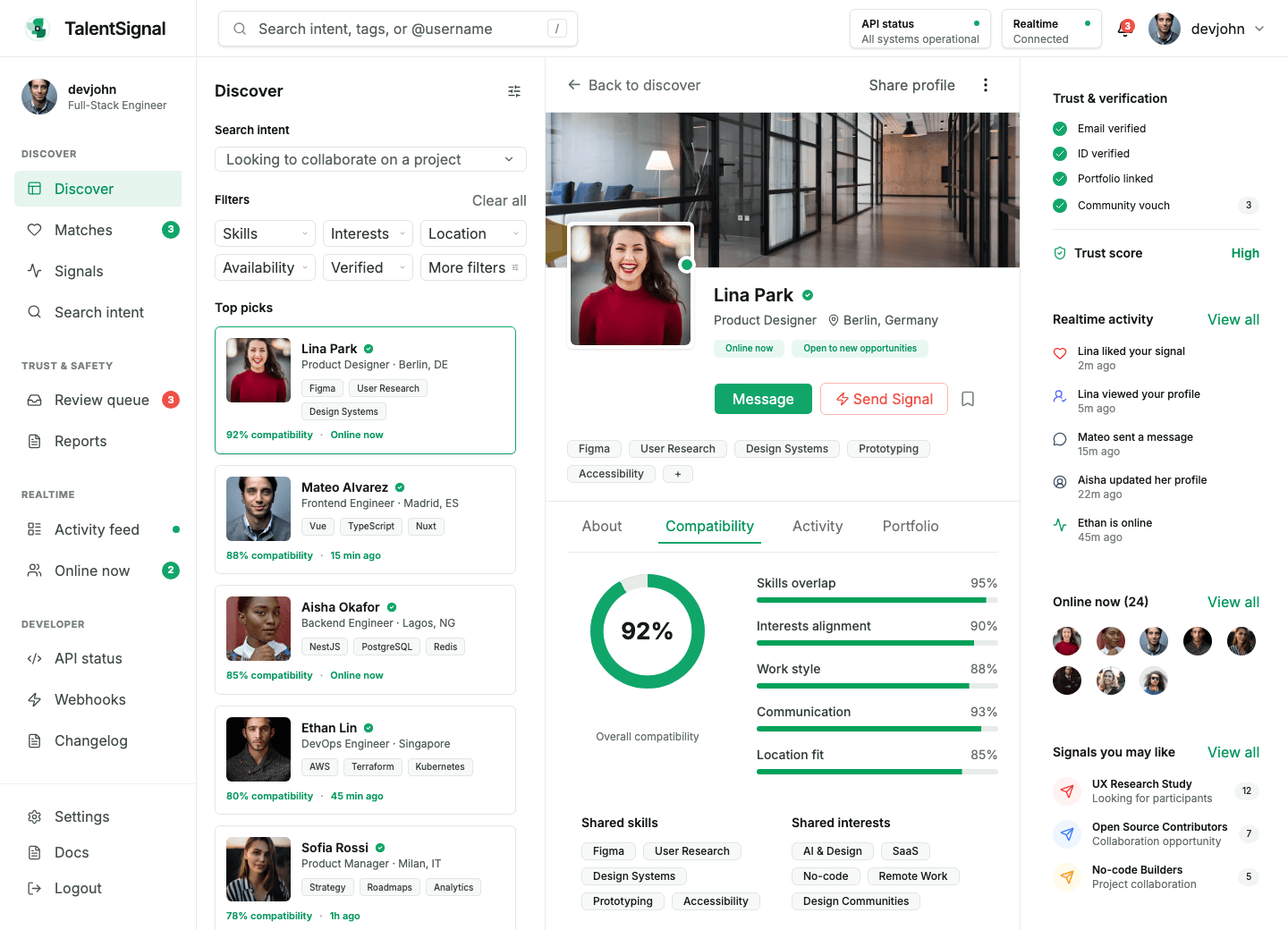
The main screen is intentionally dense: a left discovery rail for intent and filters, a selected profile workspace in the center, and a right rail for trust, activity, online presence, and suggested signals. It is shaped like a tool a small remote team could keep open during daily sourcing or community operations.
Product workflow
The discovery list supports intent, skills, interests, location, availability, and verification filters. Selecting a profile updates the central workspace with role, location, status tags, compatibility breakdowns, shared skills, and profile tabs for about, activity, and portfolio context.
Profile actions feed the workspace state instead of being decorative buttons. Sending a signal, bookmarking, messaging, or opening review sections updates activity and secondary screens. The sidebar carries adjacent operations: matches, signals, search intent, review queue, reports, activity feed, online users, webhooks, settings, and API status.
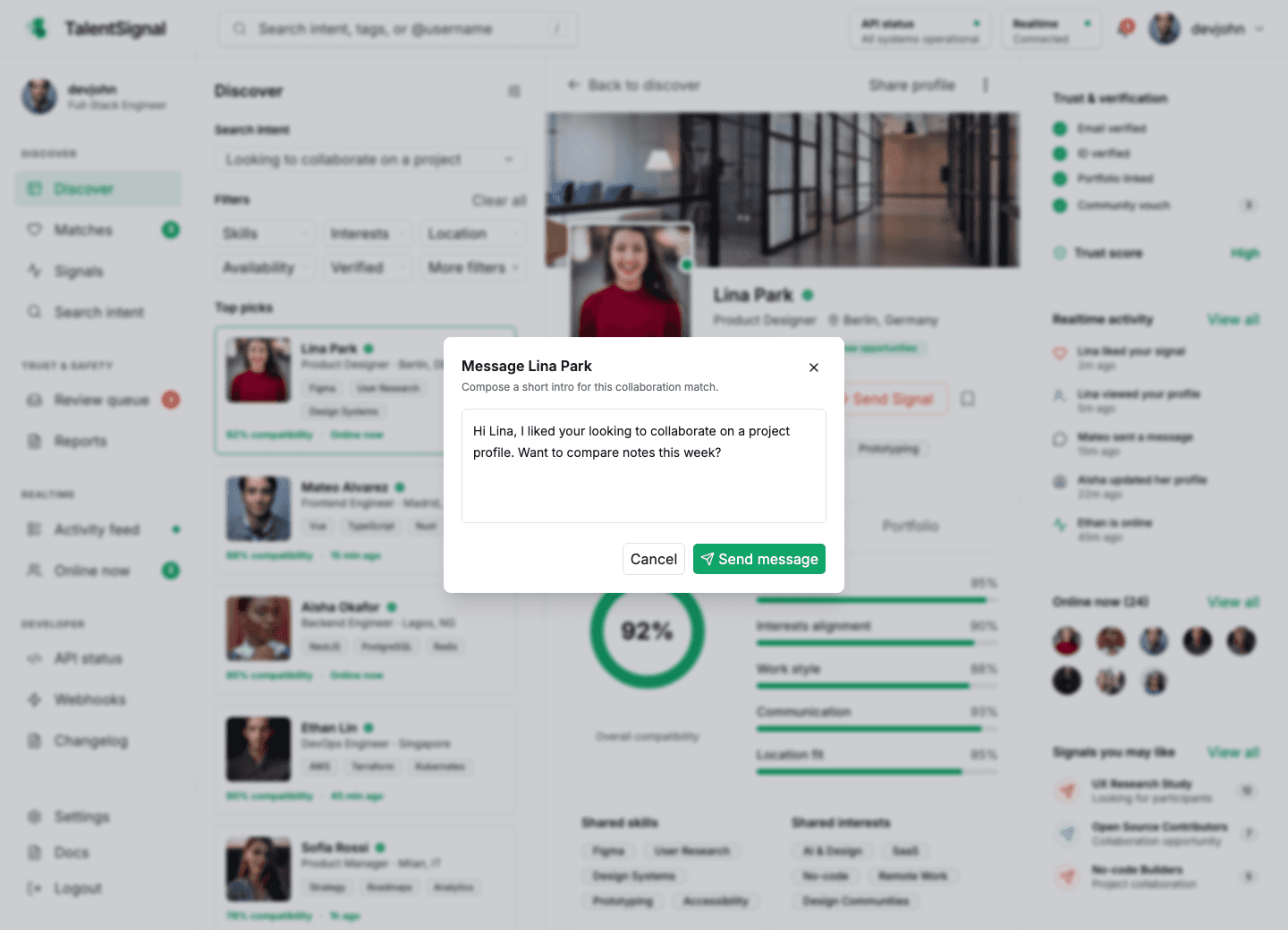
The message composer is a small example of the product philosophy: keep the interface dense, but make each action accountable. The selected profile, current intent, and outgoing message all meet in one flow instead of sending the user to a generic compose page.
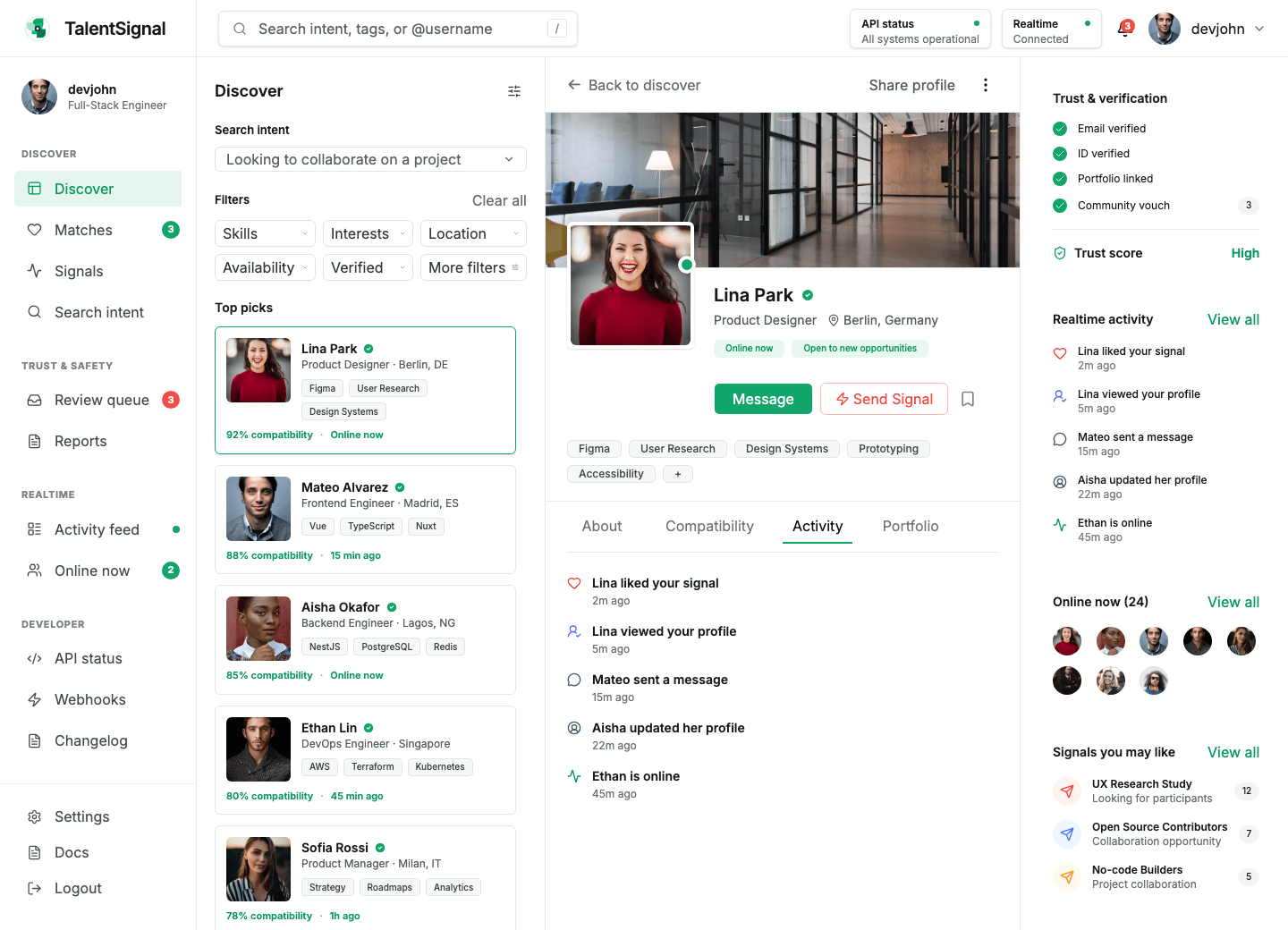
The trust rail keeps safety information close to the decision: email and ID verification, portfolio link status, community vouch count, trust score, recent activity, online users, and suggested signals all sit beside the active profile.
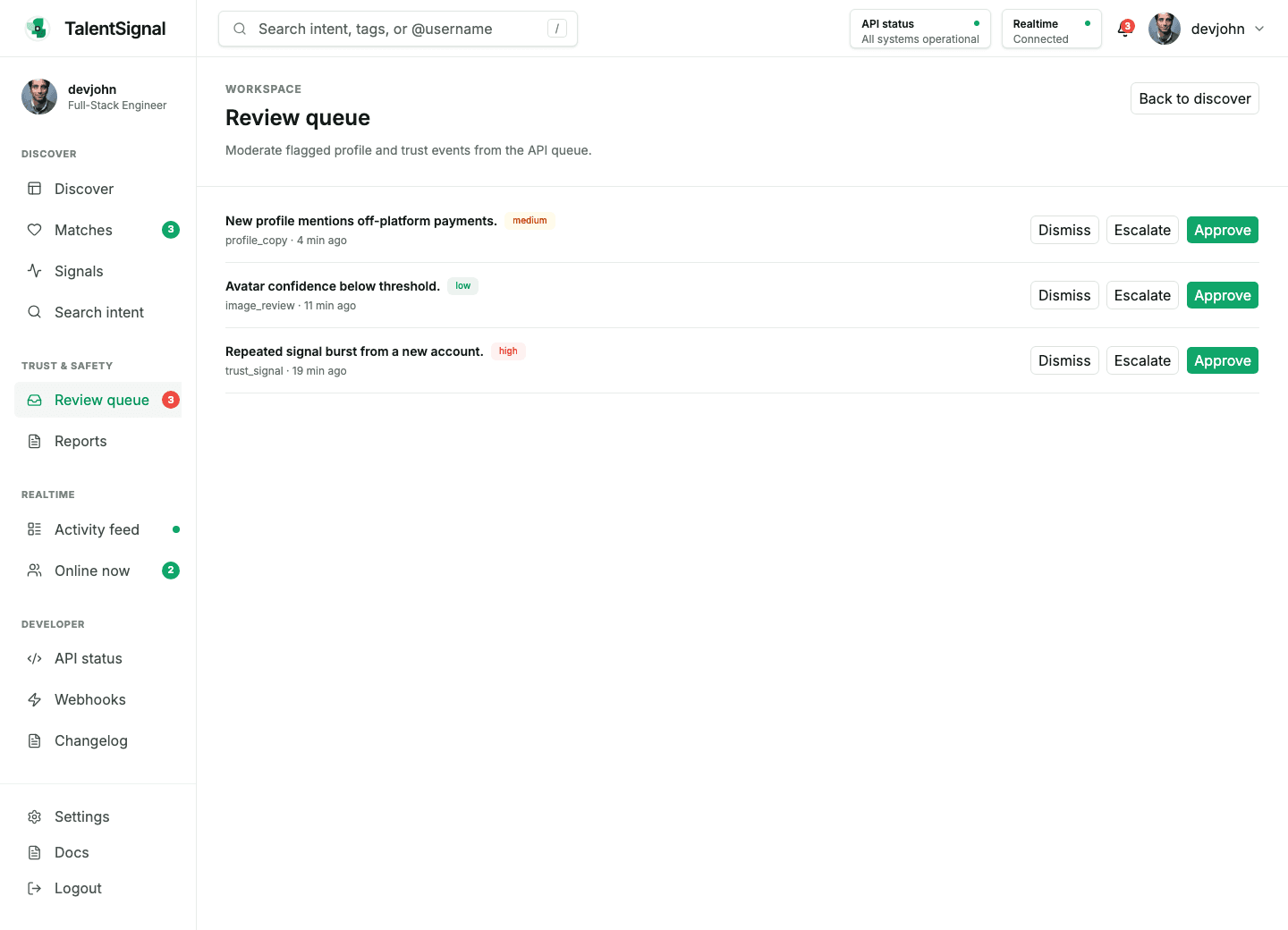
Moderation is treated as a first-class workspace section, not a hidden admin afterthought. Review items carry severity, source, and decision actions so the same product surface can support discovery and trust operations.
Architecture
Nuxt / Vue / Pinia. The frontend is organized around a typed API composable and a Pinia discovery store. Filters, search, active profile selection, profile tabs, moderation state, messages, bookmarks, signals, and activity updates all move through that shared state layer.
NestJS. The backend is split into feature modules for health, profiles, matches, search, moderation, and workspace actions. Controllers expose focused routes, DTOs validate input, a demo auth guard protects the API surface, and a request-context interceptor records timing and request metadata.
Data and infra. The data layer is SQL-ready, with repository boundaries and a MySQL schema for persistence. Redis, DynamoDB, and OpenSearch sit behind adapters so caching, audit trails, and search indexing can be connected without rewriting product code.
API contract. Swagger documents the backend at the deployed API URL. That makes the product easy to inspect from both sides: the UI shows the workflow, while the API docs expose the modules and route contracts behind it.
Deployment
TalentSignal is deployed as two Vercel projects: one for the Nuxt frontend and one for the NestJS API. The frontend reads NUXT_PUBLIC_API_BASE in production, and the API exposes /api/health plus /docs for quick operational checks.
The split mirrors how I would hand off a small product team surface: frontend and backend can deploy independently, the API contract is visible, and the product remains easy to run locally or inspect from the live links.