The pitch
Injective is a Cosmos SDK chain with a fully on-chain order book — which makes it a good stress test for frontend craft: the data is real, dense, and arrives over gRPC-web whether your UI is ready for it or not. This terminal is one focused project that touches the whole stack: wallet integration, bech32 addresses, bank balances, indexer market data, and a live order book.
The dashboard is a single screen with three panels: wallet + balances, spot markets, and a live order book with price and depth charts. Everything renders real testnet data — there are no fixtures and no demo mode.
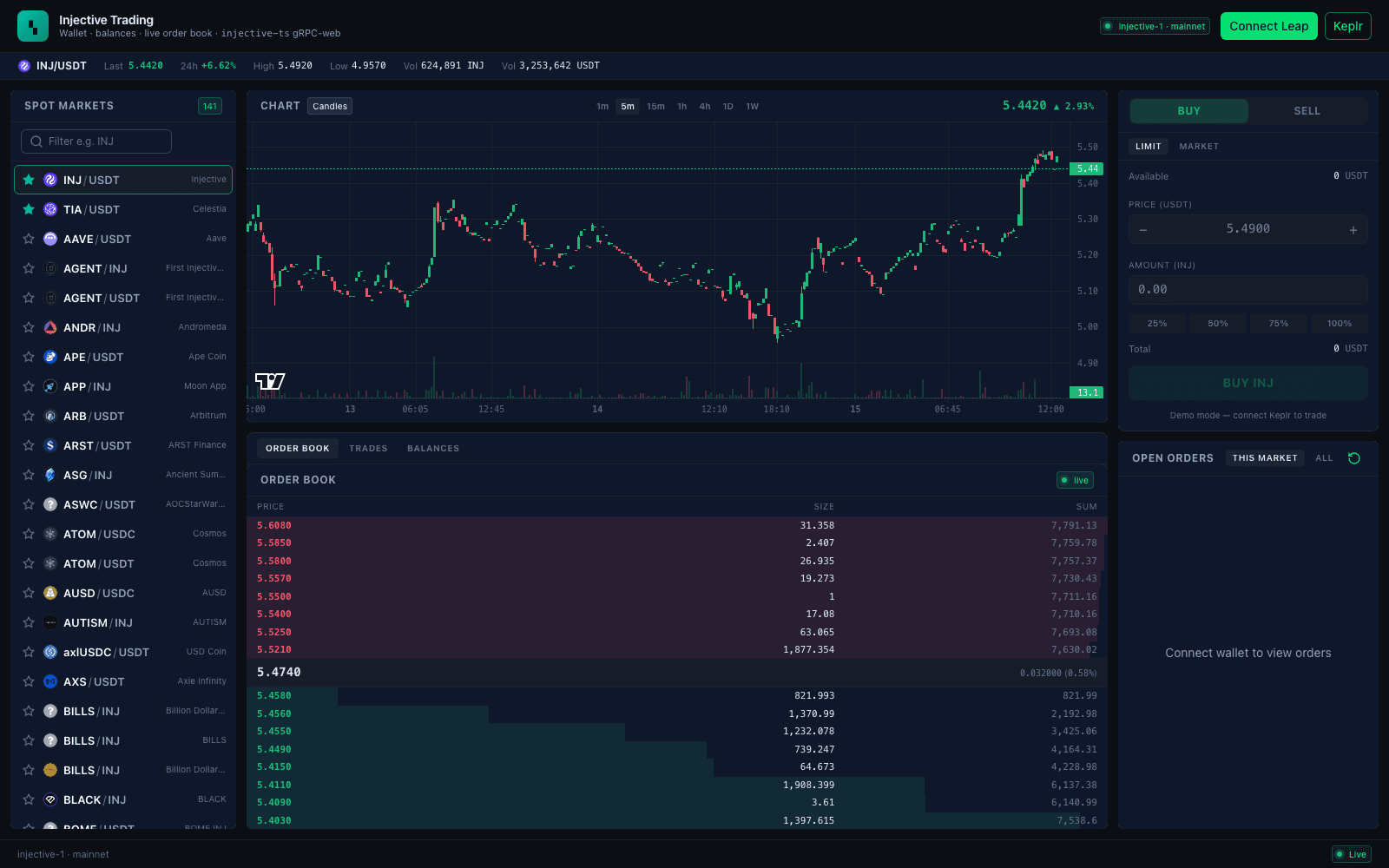
The order book is the hard part
An order book is the most demanding everyday component in trading UI: two dense columns of bids and asks, cumulative depth bars behind each row, a spread readout, and constant updates. The terminal polls fetchOrderbookV2 every ~2.5 seconds and re-renders depth bars against the largest cumulative side, so the visual weight of the book is readable at a glance.
On-chain values arrive as raw integers with per-market decimals, so a utils/inj-format.ts layer handles the scaling from chain units to human price/quantity before anything reaches the template. Keeping that conversion in one place is what makes the dense UI trustworthy — a misplaced decimal in a trading interface is not a cosmetic bug.
Hand-rolled SVG charts
Both charts — the recent-trades price area and the cumulative bid/ask depth curve — are plain SVG written by hand. No chart library: full control over the visual language, no bundle weight, and no SSR/hydration risk. For production candlesticks the natural choice would be TradingView Lightweight Charts (what Injective's own UI uses), but for a terminal this size, two honest SVG panels say more than a heavy dependency.
Zero-friction review
Every panel loads immediately with real data and no wallet required — chain reads are public. The balances panel defaults to a funded read-only demo address, so anyone opening the link sees actual balances without installing Keplr. Connecting a wallet just switches the panel to your own address. That decision matters for a portfolio piece: the evidence has to work for a reviewer who will never click "connect."
Stack decisions
Client-only rendering (ssr: false). The Injective SDK pulls in node-oriented dependencies, so the app runs as a SPA with vite-plugin-node-polyfills providing Buffer/global/process in the browser. The wallet is a browser extension anyway — client-only is the logically correct home for it, not a workaround.
gRPC-web over REST. Chain reads go through the injective-ts gRPC-web clients (ChainGrpcBankApi, IndexerGrpcSpotApi) — typed, streaming-capable, and the same transport Injective's own tooling uses.
One composable owns the chain. useInjective.ts holds the gRPC clients, wallet strategy, and reactive state; components stay presentational. Polling lives in the page, not scattered across panels.
What it shows
- Dense financial UI: a two-sided order book with depth bars and spread that stays legible under constant updates.
- Real integration, not a mock: wallet strategy packages, bech32 addresses, gRPC-web transport, on-chain unit scaling.
- Review-friendly defaults: read-only demo address means the evidence loads for anyone, instantly.
- Dependency discipline: hand-rolled SVG charts where a library would only add weight.